
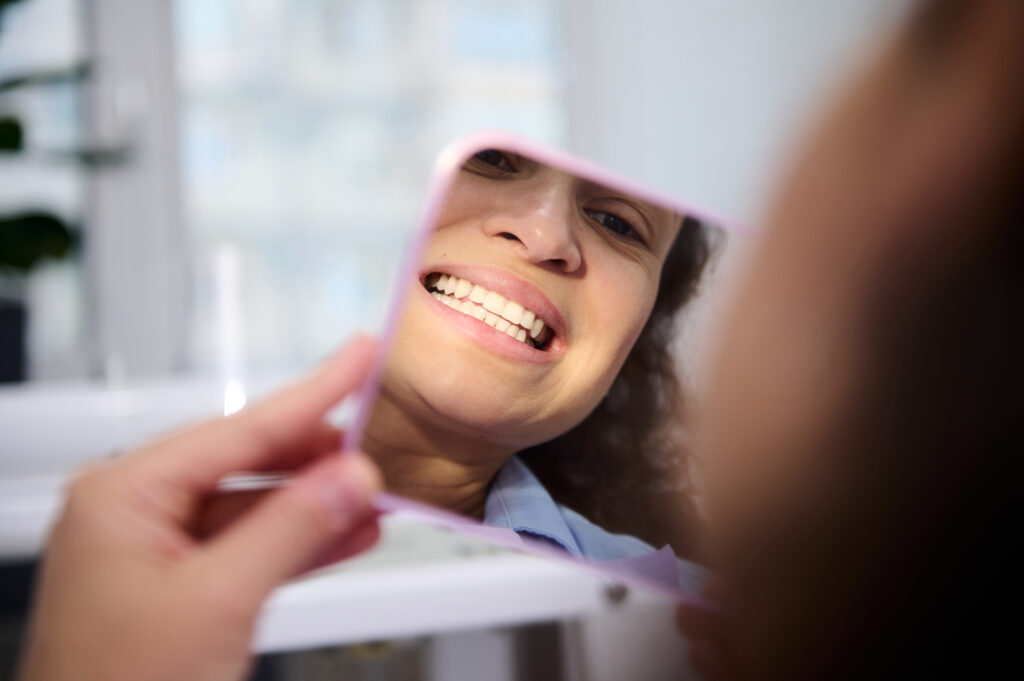
Teeth whitening approaches vary considerably in their mechanisms, outcomes, and clinical applications. Professional treatments employ peroxide concentrations of 15-43%, while consumer products contain 3-10% formulations. Research indicates measurable differences in efficacy, treatment duration, and adverse event profiles between these modalities. The selection criteria remain multifactorial, involving patient-specific variables and treatment objectives. Current evidence suggests distinct advantages and limitations for each approach that warrant careful consideration before initiating any whitening protocol.
How Professional Teeth Whitening Works at the Dentist’s Office
Professional teeth whitening procedures performed in dental offices typically employ hydrogen peroxide or carbamide peroxide in concentrations ranging from 15% to 43%, considerably higher than over-the-counter formulations. Dental office protocols begin with protective barrier application to gingival tissues, preventing chemical irritation from concentrated bleaching agents. Dentists utilize thorough whitening techniques including light-activated systems, though recent studies question photocatalytic enhancement efficacy.
Treatment duration varies between 60-90 minutes, often requiring multiple sessions for ideal results. Pre-treatment examination identifies contraindications such as enamel erosion, exposed dentin, or untreated caries. Custom-fabricated trays guarantee uniform gel distribution across tooth surfaces. Post-procedural sensitivity occurs in 55-75% of patients, typically resolving within 48 hours. Clinical evidence suggests professional treatments achieve 3-8 shade improvements on standardized color scales, though individual results depend on baseline discoloration etiology.
Breaking Down Popular At-Home Whitening Methods and Technologies
Consumer-accessible whitening products utilize lower concentrations of active ingredients compared to clinical formulations, typically containing 3-10% hydrogen peroxide or 10-22% carbamide peroxide to minimize tissue damage during unsupervised application. Current at home whitening methods include strips, trays, pens, and LED devices. Strips employ polyethylene films coated with peroxide gel, maintaining contact for 30-60 minutes daily. Custom-fitted and boil-and-bite trays deliver gel uniformly across dentition, though improper fit may cause gingival irritation.
Recent at home whitening technologies incorporate LED activation systems claiming accelerated results, though peer-reviewed studies demonstrate inconsistent efficacy compared to non-illuminated applications. Paint-on gels and whitening pens offer targeted application but exhibit limited substantivity. Over-the-counter formulations require extended treatment periods of 7-14 days, with results varying based on initial tooth shade, enamel porosity, and patient compliance with manufacturer protocols.
Comparing Costs: Initial Investment and Long-Term Value
When evaluating whitening treatment modalities, financial considerations encompass both immediate expenses and maintenance requirements over extended periods. Professional in-office treatments typically range from $300-$1,000 per session, with results lasting 1-3 years depending on dietary habits and oral hygiene practices. Conversely, at-home systems present more budget friendly options, costing $20-$200 initially, though requiring frequent reapplication every 3-6 months.
Cost comparison analyses reveal professional treatments demonstrate superior value for patients seeking dramatic, rapid results despite higher upfront investment. At-home alternatives prove economically advantageous for individuals with mild discoloration requiring gradual improvement. Long-term expenses vary considerably based on treatment frequency, with professional touch-ups costing $100-$300 annually versus $50-$150 for at-home maintenance. Clinical evidence suggests combining modalities—professional treatment followed by at-home maintenance—may optimize both efficacy and economic efficiency.
Expected Results Timeline for Each Whitening Approach
The temporal progression of tooth whitening outcomes varies dramatically between professional and at-home treatment modalities. Professional in-office procedures typically demonstrate observable results within 60-90 minutes of application, with maximum lightening achieved after one to three sessions spaced approximately two weeks apart. Conversely, at-home whitening systems generally require 10-14 days of consistent daily application to produce initial visible changes, with excellent results manifesting after four to six weeks of continued use.
Professional Treatment Timeline
Although professional whitening treatments typically yield more dramatic results than at-home alternatives, the timeline for achieving ideal outcomes varies considerably based on the specific clinical protocol employed. In-office bleaching sessions demonstrate immediate effects, with patients observing 3-8 shade improvements within a single 60-90 minute procedure duration. Most practitioners recommend one to three sessions, with appointment frequency determined by baseline tooth coloration and patient-specific response rates.
Research indicates excellent results manifest within 24-48 hours post-treatment as oxygen molecules continue penetrating enamel microstructures. Maximum whitening efficacy stabilizes approximately seven days following the final session. Clinical studies document sustained results lasting 12-36 months, contingent upon dietary habits and maintenance protocols. Dentists typically advise 14-day intervals between successive treatments to minimize potential dentinal hypersensitivity while maximizing cumulative bleaching effects.
At-Home Results Schedule
Consistently, at-home whitening systems require extended treatment periods compared to professional interventions, with observable results manifesting gradually over 7-21 days depending on product formulation and concentration. Strip-based treatments typically demonstrate initial color improvement within 3-5 days, reaching maximum efficacy after 14 consecutive applications. Tray systems with 10-15% carbamide peroxide yield measurable shade changes after one week, though ideal outcomes necessitate 2-3 weeks of nightly application.
Establishing realistic whitening expectations remains vital, as individual response varies based on baseline tooth shade, enamel thickness, and adherence to customized whitening schedules. Clinical studies indicate 2-4 shade improvements represent typical outcomes for over-the-counter products, while prescription-strength formulations may achieve 3-6 shade enhancements. Maintenance protocols require reapplication every 3-6 months to sustain achieved results.
Managing Tooth Sensitivity and Potential Side Effects
Most patients undergoing teeth whitening procedures experience transient dentin hypersensitivity, with reported incidence rates ranging from 18% to 78% depending on the concentration of peroxide agents and duration of treatment. Professional supervision enables immediate intervention for reducing discomfort through desensitizing agents containing potassium nitrate or fluoride varnishes. Clinicians monitor gingival irritation and adjust treatment protocols correspondingly, preventing enamel damage through controlled application techniques.
At-home systems present higher risks of overuse, potentially causing irreversible enamel erosion when manufacturer guidelines are exceeded. Common adverse effects include thermal sensitivity lasting 24-48 hours post-treatment and mild soft tissue inflammation from tray overflow. Evidence suggests pre-treatment with desensitizing toothpaste containing 5% potassium nitrate for two weeks markedly decreases sensitivity incidence. Both modalities require careful patient selection, excluding individuals with exposed dentin, untreated caries, or compromised enamel integrity.
Who Makes the Best Candidate for Professional Vs At-Home Treatment
While individual patient characteristics determine ideal whitening modality selection, clinical assessment reveals distinct candidacy criteria for professional versus at-home treatments. Professional whitening suits patients with intrinsic staining, tetracycline discoloration, or those requiring rapid results. These individuals benefit from higher peroxide concentrations and controlled application under clinical supervision.
Conversely, at-home treatment candidates typically present mild-to-moderate extrinsic staining, demonstrate excellent compliance, and possess healthy enamel. Genetics impact whitening results through variations in enamel thickness and dentin shade, influencing treatment response regardless of modality chosen. Dental history affects suitability extensively—patients with extensive restorations, recurrent caries, or periodontal disease require professional oversight. Those with minimal sensitivity, no active pathology, and realistic expectations may successfully utilize at-home systems. Contraindications for both modalities include pregnancy, lactation, and patients under sixteen years.
Maintenance Requirements and Longevity of Results
The longevity of whitening results varies considerably between professional and at-home treatments, with professional procedures typically maintaining visible effects for 1-3 years compared to 3-6 months for over-the-counter options. Both modalities require adherence to specific daily oral hygiene protocols, including the use of whitening toothpaste and avoidance of chromogenic substances such as coffee, tea, and tobacco products. Touch-up treatments are generally recommended quarterly for at-home systems and annually for professional treatments, though individual variation in enamel porosity and dietary habits may necessitate adjusted maintenance schedules.
Daily Care Routines
Post-treatment maintenance protocols profoundly influence the duration of whitening outcomes for both professional and at-home systems. Clinical evidence suggests that structured morning routines incorporating fluoride-containing dentifrice and thorough mechanical plaque removal extend results by 40-60% compared to inconsistent oral hygiene practices. Practitioners recommend waiting 30-60 minutes post-consumption of acidic beverages before brushing to prevent enamel erosion.
Evening habits prove equally critical for maintaining achieved shade improvements. Studies indicate that nocturnal application of desensitizing agents containing potassium nitrate or calcium phosphate compounds reduces post-whitening sensitivity while preserving enamel integrity. Additionally, implementing non-abrasive cleaning techniques and avoiding chromogenic substances during the 48-hour post-treatment window greatly impacts long-term stability. Research demonstrates that patients adhering to prescribed twice-daily protocols maintain ideal results for 12-24 months, whereas non-compliant individuals experience notable regression within 3-6 months.
Touch-Up Treatment Schedules
Although initial whitening procedures achieve substantial shade improvement, periodic touch-up treatments remain essential for sustaining ideal aesthetic outcomes over extended timeframes. Professional treatments typically maintain results for 12-24 months before requiring intervention, while at-home systems necessitate more frequent applications, generally every 3-6 months.
Optimal touch up frequency depends on multiple variables including dietary habits, oral hygiene compliance, and intrinsic staining susceptibility. Patients consuming chromogenic substances require accelerated maintenance protocols. Research indicates proper scheduling involves professional reassessment biannually, with supplementary at-home applications administered quarterly for maximum efficacy.
Clinical evidence suggests combination approaches yield superior longevity. Professional treatments followed by prescribed at-home maintenance demonstrate 40% longer duration compared to singular modalities. Practitioners recommend customized protocols based on individual staining patterns and lifestyle factors to optimize aesthetic retention.
Making Your Decision: Key Factors to Consider Before Whitening
Several critical factors warrant careful evaluation before initiating any tooth whitening procedure, whether professional or at-home. Individuals must assess their dental health status, including existing restorations, enamel thickness, and presence of intrinsic staining patterns that may affect treatment outcomes.
Personal goals regarding shade improvement should align with realistic expectations based on baseline tooth color and staining etiology. Budget constraints considerably influence treatment selection, as professional procedures typically range from $300-1,500, while at-home systems cost $20-200.
Pre-existing dental conditions, particularly dentinal hypersensitivity and gingival recession, require thorough assessment. Patients with tetracycline staining or fluorosis may experience limited results regardless of method chosen. Time availability represents another determinant, as in-office treatments provide immediate results versus the 2-6 week timeline for at-home applications.
Frequently Asked Questions
Can I Whiten My Teeth if I Have Crowns or Veneers?
Patients with crowns or veneers should generally avoid whitening procedures as these restorations won’t change color. Treatment feasibility depends on crown/veneer material composition. Whitening may create uneven coloration between natural teeth and existing restorations.
Will Teeth Whitening Remove Stains From Smoking or Coffee?
Teeth whitening demonstrates moderate efficacy in reducing cigarette stains and reducing coffee stains through oxidative breakdown of chromogenic compounds. However, results vary based on stain severity, enamel porosity, and treatment modality. Deep intrinsic discoloration may show limited improvement.
Is Teeth Whitening Safe During Pregnancy or While Breastfeeding?
Most dental professionals recommend postponing teeth whitening during pregnancy and breastfeeding due to insufficient safety data. Potential teeth sensitivity and unknown risks to developing teeth in fetuses warrant caution, though no definitive harmful effects have been established.
How Soon Before a Special Event Should I Start Whitening?
Dental professionals recommend patients schedule whitening treatments 2-4 weeks before special events. Professional treatments show results within 1-2 visits, while at-home systems require 10-14 days minimum time whitening starts to achieve ideal shade improvement.
Can Teenagers Safely Use Teeth Whitening Products?
Dental professionals generally recommend waiting until appropriate age for whitening, typically after age 14 when enamel fully matures. Potential side effects of whitening include heightened sensitivity and gingival irritation, requiring careful evaluation of adolescent candidacy beforehand.