
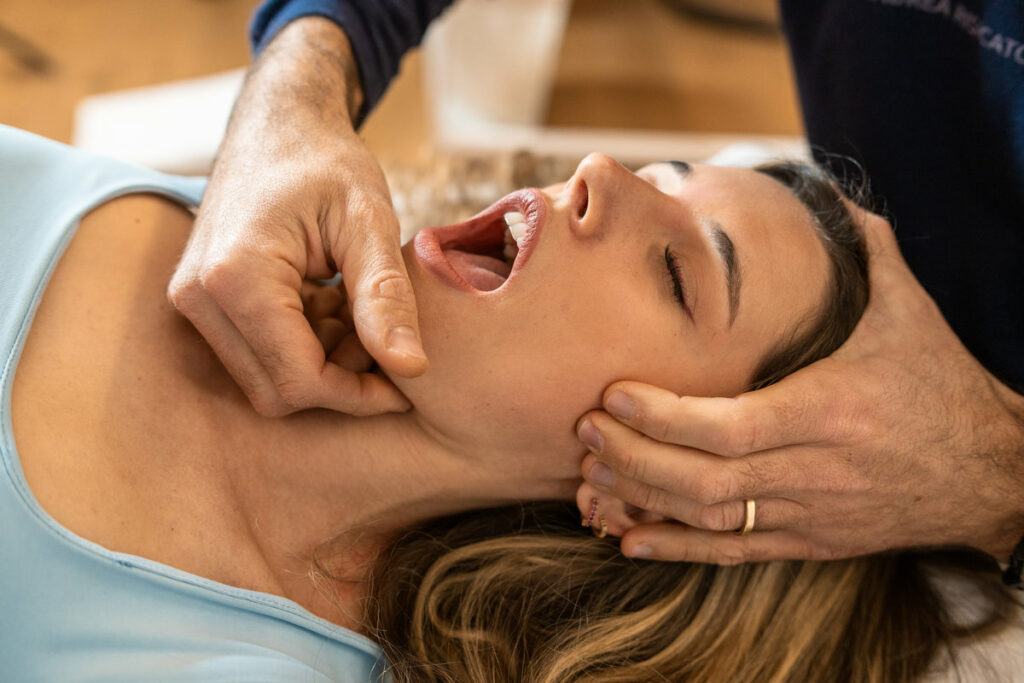
The temporomandibular joint connects the mandible to the temporal bone through a complex network of muscles, ligaments, and cartilage. When this system malfunctions, patients experience pain, clicking, and restricted jaw movement. Research demonstrates that targeted therapeutic exercises can reduce symptoms in 70% of TMJ disorder cases. The following evidence-based protocol progresses from basic mobilization to advanced strengthening techniques. Each exercise targets specific anatomical structures responsible for jaw dysfunction.
Understanding TMJ Disorders and Their Impact on Daily Life
When the temporomandibular joint complex becomes dysfunctional, it disrupts the intricate biomechanical relationship between the mandibular condyle, articular disc, and glenoid fossa of the temporal bone. This dysfunction manifests through multiple pathophysiological mechanisms affecting mastication, speech, and craniocervical stability.
Primary causes of TMJ disorders include malocclusion, bruxism, direct trauma, inflammatory arthropathies, and sustained muscular hypertonicity of the masticatory complex. Secondary factors encompass cervical spine dysfunction, forward head posture, and systemic connective tissue disorders.
The impact of TMJ on sleep quality proves significant, with nocturnal bruxism perpetuating joint degeneration while pain-induced sleep fragmentation disrupts restorative sleep phases. Patients experience compromised REM cycles, increased arousal indices, and subsequent daytime fatigue. These sleep disturbances create a cyclical pattern where poor sleep quality exacerbates muscular tension, further compromising joint mechanics.
Gentle Jaw Stretching Exercises for Immediate Relief
Although acute TMJ dysfunction often triggers protective muscle guarding throughout the masticatory system, targeted stretching exercises can effectively interrupt this pain-spasm cycle by promoting gradual lengthening of the lateral pterygoid, masseter, and temporalis muscles. Clinicians recommend initiating treatment with heat and cold therapy applications—moist heat for 10 minutes preceding exercise, followed by cryotherapy post-stretching to minimize inflammatory response.
The fundamental stretch involves controlled mandibular depression: patients place their thumb on maxillary incisors while the index finger contacts mandibular incisors, applying gentle traction for 6-second intervals. Progressive resistance exercises follow, incorporating isometric contractions against manual resistance. Concurrent jaw massage techniques targeting trigger points within the masseter enhance stretch efficacy. Patients advance through three difficulty phases: passive range-of-motion, active-assisted stretching, and finally, resistive exercises against calibrated pressure.
Resistance Training Techniques to Strengthen Jaw Muscles
Once patients achieve adequate pain-free range of motion through stretching protocols, resistance training becomes essential for restoring excellent neuromuscular control and preventing recurrent TMJ dysfunction through systematic strengthening of the masticatory musculature. Initial isometric jaw clenching exercises involve placing the fist beneath the chin while attempting controlled opening against resistance for five-second holds. Targeted masseter exercises progress from bilateral activation using thumb resistance against lateral jaw movements to unilateral strengthening protocols.
Advanced techniques incorporate progressive resistance bands positioned extraorally to challenge closing mechanics in multiple vectors. Practitioners recommend three sets of ten repetitions, performed twice daily, with resistance calibrated to produce mild muscular fatigue without joint discomfort. Systematic progression through these evidence-based protocols typically yields measurable improvements in bite force and endurance within four to six weeks.
Tongue and Soft Palate Exercises for TMJ Support
Beyond strengthening the primary masticatory muscles, ideal TMJ rehabilitation requires addressing the intrinsic oral musculature that provides indirect biomechanical support to the temporomandibular complex. Tongue mobilization techniques begin with placing the tongue tip against the posterior incisive papilla while maintaining mandibular rest position. Practitioners progress through lateral sweeps along the palatal rugae, followed by sustained pressure holds lasting 5-10 seconds against specific palatal landmarks.
Soft palate stretches involve controlled yawning movements with progressive mouth opening angles, activating the tensor veli palatini and levator veli palatini muscles. These exercises enhance proprioceptive awareness and neuromuscular coordination between the oropharyngeal structures and TMJ apparatus. Clinical evidence demonstrates that incorporating these techniques reduces parafunctional habits, optimizes tongue posture, and decreases compensatory muscle tension patterns affecting temporomandibular joint mechanics.
Neck and Shoulder Stretches That Reduce Jaw Tension
Since cervical spine dysfunction directly influences temporomandibular joint biomechanics through shared myofascial connections, targeted neck and shoulder stretching protocols address the craniocervical-mandibular system as an integrated functional unit. Head tilting exercises systematically elongate the sternocleidomastoid, upper trapezius, and levator scapulae muscles, reducing compensatory jaw clenching patterns. Lateral cervical flexion combined with contralateral shoulder depression maximizes fascial release through the superficial cervical chain.
Upper back mobility work targets thoracic extension deficits that perpetuate forward head posture and subsequent mandibular retrusion. Scapular retraction exercises restore ideal glenohumeral positioning, alleviating tension transmission through the omohyoid muscle to the hyoid bone complex. Progressive resistance protocols incorporate isometric holds at end-range positions, facilitating neuromuscular re-education while maintaining therapeutic stretch intensity for measurable TMJ symptom reduction.
Relaxation and Breathing Techniques for TMJ Management
Stress-induced muscle tension directly contributes to temporomandibular joint dysfunction through sustained contraction of the masseter, temporalis, and associated cervical musculature. Systematic relaxation techniques target the autonomic nervous system to reduce sympathetic activation and promote parasympathetic dominance, thereby decreasing overall muscle tone in the craniofacial region. The following evidence-based interventions—deep diaphragmatic breathing, progressive muscle relaxation, and mindful jaw release—form a hierarchical approach to managing TMJ-related muscular hyperactivity and pain.
Deep Diaphragmatic Breathing
Although the temporomandibular joint appears anatomically distant from the diaphragm, chronic shallow thoracic breathing patterns directly contribute to increased muscle tension throughout the craniocervical region, including the masticatory muscles. Deep diaphragmatic breathing counteracts this maladaptive pattern by activating the parasympathetic nervous system, reducing sympathetic overdrive that perpetuates TMJ dysfunction.
Proper technique requires supine positioning with one hand on the chest, another on the abdomen. During inhalation, the abdominal hand rises while the thoracic hand remains relatively static, confirming diaphragmatic control. Practitioners should maintain paced breathing at 4-7-8 counts: inhale for four, hold for seven, exhale for eight. This temporal ratio optimizes vagal tone and promotes descending inhibition of nociceptive pathways. Regular practice, performed twice daily for 5-10 minutes, demonstrates measurable reductions in masseter and temporalis muscle activity via surface electromyography.
Progressive Muscle Relaxation
While diaphragmatic breathing addresses autonomic dysregulation, progressive muscle relaxation (PMR) targets the somatic component of TMJ dysfunction through systematic tensing and releasing of specific muscle groups. This technique cultivates mindful awareness of muscular tension patterns, particularly in the masticatory complex, cervical spine, and shoulder girdle.
PMR protocols for TMJ patients begin with distal muscle groups, progressing proximally toward the orofacial region. Patients contract target muscles for 5-7 seconds at 30% maximum voluntary contraction, followed by 15-20 seconds of complete relaxation. This creates proprioceptive contrast, enhancing recognition of pathological holding patterns.
Research demonstrates PMR’s efficacy in stress management, reducing masseter and temporalis EMG activity by 40-60%. The technique disrupts the pain-tension cycle by downregulating sympathetic tone and decreasing nociceptive input from myofascial trigger points.
Mindful Jaw Release
The mindful jaw release technique integrates proprioceptive awareness with controlled mandibular decompression to address chronic muscular hypertonicity in the temporomandibular complex. This method requires patients to cultivate mindful jaw awareness through systematic attention to masseter and temporalis muscle tension patterns while maintaining diaphragmatic breathing.
Practitioners position the tongue against the palate, allowing passive mandibular descent through gravitational forces rather than active depression. This conscious muscle release promotes neuromuscular re-education by interrupting maladaptive clenching reflexes. Research demonstrates that combining focused attention with physiological relaxation reduces electromyographic activity in masticatory muscles by 40-60%.
Advanced progression involves lateral pterygoid engagement through controlled eccentric movements, coordinating exhalation with gradual jaw opening. Patients monitor tension asymmetries between bilateral muscle groups, adjusting release patterns accordingly. Duration increases from 30-second to 3-minute intervals over successive sessions.
Proper Jaw Posture and Alignment Exercises
Maintaining ideal temporomandibular joint alignment requires conscious repositioning of mandibular structures through specific postural exercises. The resting jaw position establishes a 2-3mm freeway space between upper and lower teeth while the chin tuck technique realigns the cervical spine to reduce forward head posture and subsequent joint compression. Advanced tongue placement methods position the anterior third of the tongue against the palatal rugae, facilitating proper maxillary development and reducing excessive masseter activation.
Resting Jaw Position
When the jaw maintains its ideal resting position, the temporomandibular joint experiences minimal stress and the surrounding musculature remains in a balanced state of low-level tonus. The natural jaw position involves teeth slightly separated by approximately 2-3 millimeters, with the tongue tip resting gently against the palatal surface posterior to the maxillary incisors. This ideal resting posture prevents excessive loading of articular surfaces and reduces parafunctional muscle activity.
Patients should practice conscious proprioceptive awareness throughout daily activities. The mandible assumes a freeway space position through reciprocal inhibition of elevator and depressor muscle groups. Lips remain lightly closed without tension while maintaining nasal breathing patterns. Deviation from this neutral position triggers compensatory muscle recruitment, potentially exacerbating TMJ dysfunction. Regular self-monitoring reinforces neuromuscular reprogramming essential for symptom reduction.
Chin Tuck Technique
As cervical spine alignment directly influences temporomandibular joint mechanics, the chin tuck technique serves as a fundamental corrective exercise for addressing forward head posture and associated mandibular malpositioning. This isometric contraction engages deep cervical flexors while elongating suboccipital extensors, restoring ideal craniocervical relationships.
Execution requires posterior gliding of the occiput while maintaining horizontal gaze direction. Practitioners position themselves against a wall, retracting the chin posteriorly without flexing or extending the neck. The maneuver creates cervical elongation, reducing compressive forces on retrodiscal tissues. Proper chin alignment facilitates balanced masticatory muscle activation and decreases abnormal joint loading patterns.
Progressive variations include resistance application and sustained holds of 5-10 seconds. Research demonstrates significant reduction in TMJ symptoms following 6-8 weeks of consistent practice, with improvements in condylar positioning verified through imaging studies.
Tongue Placement Methods
Three distinct tongue positioning protocols demonstrate measurable efficacy in establishing ideal mandibular rest position and reducing parafunctional muscle tension. The fundamental N-spot technique requires placing the tongue tip behind upper incisors while maintaining light palatal contact throughout the dorsum. This baseline position facilitates neuromuscular reprogramming of the temporalis and masseter complexes.
Advanced tongue positioning techniques incorporate isometric resistance training. Practitioners apply upward pressure against the hard palate for ten-second intervals, activating intrinsic lingual musculature while promoting physiological jaw spacing. The posterior third elevation method specifically targets digastric hypertonicity through sustained soft palate engagement.
Tongue strengthening exercises progress from static holds to dynamic movements. Lateral sweeps along the palatal rugae enhance proprioceptive awareness, while circumferential rotations against closed teeth develop coordinated muscle control essential for maintaining therapeutic mandibular positioning.
Creating an Effective Daily TMJ Exercise Routine
Because temporomandibular joint dysfunction affects approximately 12% of the population with varying severity levels, establishing a structured daily exercise protocol requires careful consideration of individual biomechanical limitations and pain thresholds. Patients should initiate their routine with gentle jaw mobility techniques, performing controlled opening movements within pain-free ranges for 5-10 repetitions twice daily.
Following mobility work, practitioners recommend incorporating isometric jaw exercises targeting the lateral pterygoid and masseter muscles. These involve applying resistance against mandibular movement without actual joint displacement, holding for 5-7 seconds per repetition. Progressive loading should increase incrementally over 2-3 week intervals.
Optimal scheduling involves morning sessions addressing joint stiffness and evening protocols emphasizing muscular relaxation. Patients experiencing acute inflammation should reduce exercise frequency to alternate days until symptoms stabilize.
Frequently Asked Questions
Can I Do TMJ Exercises if I Wear Braces or Retainers?
Patients wearing braces or using dental appliances can safely perform TMJ exercises. Orthodontic hardware doesn’t interfere with jaw mobility exercises, though individuals should start with gentle movements and progressively increase intensity while monitoring comfort levels.
How Long Before TMJ Exercises Show Noticeable Pain Relief Results?
Patients typically experience immediate pain reduction within 2-3 weeks of consistent TMJ exercises, though gradual long term improvement requires 6-12 weeks. Individual response varies based on disorder severity, exercise compliance, and underlying anatomical dysfunction patterns.
Should I Stop Exercising if My Jaw Clicks During Movements?
Individuals experiencing jaw clicking should avoid high impact activities but may continue gentle exercises unless pain occurs. One should consult with dentist prior to progressing movements. Painless clicking typically indicates disc displacement without immediate concern.
Are TMJ Exercises Safe to Perform During Pregnancy?
TMJ exercises remain safe during pregnancy when incorporating appropriate posture modifications. Evidence indicates gentle jaw massage techniques pose no gestational risks. Practitioners recommend progressive difficulty adjustments, avoiding supine positions after first trimester while maintaining cervical spine alignment.
Can Children With TMJ Disorders Do These Same Exercises?
Children require modified approaches through pediatric TMJ treatment protocols. Child specific exercises emphasize gentler range-of-motion movements, shorter duration holds, and reduced resistance levels. Mandibular mobilization techniques must accommodate developing craniofacial structures and immature temporomandibular joint anatomy.