
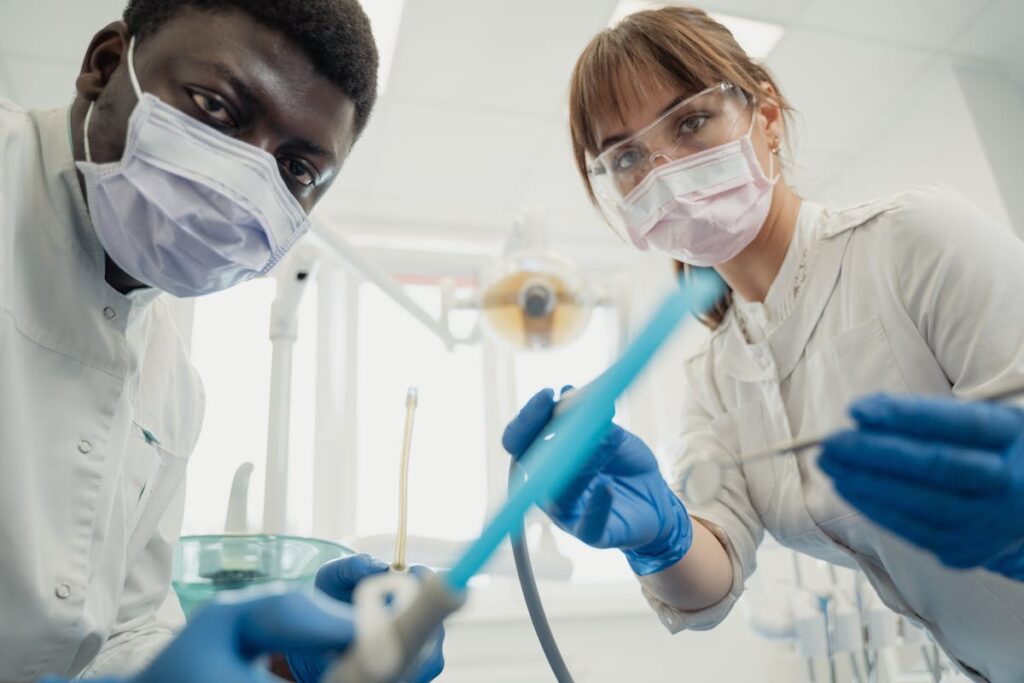
Oral surgery becomes medically indicated when non-invasive dental treatments fail to address underlying pathological conditions. Complex cases involving impacted third molars, advanced periodontitis, and skeletal malocclusions require surgical intervention to prevent disease progression and restore function. The decision between conservative management and surgical treatment depends on multiple clinical factors including radiographic findings, anatomical considerations, and patient-specific variables. Understanding these surgical thresholds proves critical for ideal treatment outcomes.
Impacted Wisdom Teeth and Extraction Requirements
When wisdom teeth fail to erupt properly through the gum line due to insufficient space or abnormal positioning, they become impacted and may require surgical extraction to prevent complications. Partial or complete impaction occurs in approximately 70% of individuals, typically manifesting between ages 17-25 during final stages of oral cavity development. Pericoronitis, cyst formation, and adjacent tooth resorption constitute primary indications for extraction. Radiographic evaluation determines angulation classification: mesioangular, distoangular, vertical, or horizontal positioning. Nutritional deficiency effects during developmental years may compromise jaw growth, increasing impaction probability. Symptomatic presentation includes pain, swelling, trismus, and purulent discharge. Asymptomatic impactions require monitoring for pathological changes. Surgical intervention involves mucoperiosteal flap elevation, bone removal, tooth sectioning when indicated, and primary closure. Contraindications include proximity to inferior alveolar nerve and systemic conditions affecting healing capacity.
Advanced Periodontal Disease Requiring Surgical Treatment
Advanced periodontal disease necessitates surgical intervention when bone loss severity exceeds 50% of the tooth’s supporting structure and non-surgical therapy fails to halt disease progression. Deep pocket formation measuring greater than 6mm with persistent bleeding on probing indicates bacterial colonization beyond the reach of conventional scaling and root planing procedures. Surgical treatment options include osseous resective surgery to eliminate bony defects, regenerative procedures utilizing bone grafts and barrier membranes, and pocket reduction surgery to restore physiologic architecture conducive to patient maintenance.
Bone Loss Severity
Severe alveolar bone loss exceeding 50% of root length characterizes advanced periodontitis cases that necessitate surgical intervention beyond conventional scaling and root planing procedures. Radiographic evaluation reveals extensive horizontal and vertical defects compromising tooth stability and prognosis. Bone density reduction manifests through trabecular pattern changes and cortical thinning, measurable through cone-beam computed tomography analysis.
Clinical assessment demonstrates tooth mobility grades II-III, pathologic migration, and furcation involvement. Inadequate bone structure prevents proper tooth support, creating pockets exceeding 6mm that harbor persistent bacterial colonization. Surgical approaches include osseous resection, guided tissue regeneration, and bone grafting procedures to restore anatomical contours. Without intervention, progressive destruction leads to tooth loss. Treatment selection depends on defect morphology, remaining bone height, and patient-specific factors including systemic health status and regenerative potential.
Deep Pocket Formation
The formation of periodontal pockets exceeding 5mm depth indicates irreversible attachment loss requiring surgical intervention for complete debridement and tissue recontouring. Standard non-surgical scaling becomes ineffective when gum pocket depth surpasses this threshold, as instrumentation cannot adequately access bacterial biofilms and calculus deposits within deep periodontal defects.
Untreated pockets facilitate anaerobic bacterial colonization, accelerating bone loss progression through inflammatory mediator release and osteoclast activation. Surgical pocket reduction procedures, including osseous recontouring and apically positioned flaps, eliminate these pathological spaces while establishing maintainable tissue architecture. Clinical studies demonstrate that pockets greater than 6mm show continued attachment loss despite meticulous maintenance therapy. Surgical intervention remains the definitive treatment for restoring periodontal health when pocket depths exceed conservative therapy limitations, preventing tooth mobility and eventual tooth loss.
Surgical Treatment Options
Multiple surgical modalities address advanced periodontal destruction through distinct mechanisms of tissue regeneration and defect elimination. Flap procedures enable direct visualization of root surfaces and osseous defects, facilitating thorough debridement and bacterial biofilm removal. Open flap debridement permits scaling of previously inaccessible areas while modified Widman flaps preserve tissue architecture during healing.
Regenerative techniques employ barrier membranes, bone grafts, and biologics to restore lost periodontal structures. Ridge augmentation reconstructs alveolar bone deficiencies through autogenous, allogeneic, or xenogeneic grafting materials, establishing adequate bone volume for implant placement or prosthetic rehabilitation. Osseous resective surgery eliminates angular bony defects through osteoplasty and osteotomy, creating positive architecture conducive to maintenance. Selection among these interventions depends on defect morphology, patient factors, and therapeutic objectives established through in-depth periodontal evaluation.
Dental Implant Placement and Bone Grafting Procedures
When adequate bone volume and density are present, dental implant placement follows established surgical protocols involving precise osteotomy preparation, implant insertion at predetermined torque values, and achievement of primary stability exceeding 35 Ncm. Insufficient osseous architecture necessitates augmentation procedures prior to or concurrent with implant placement.
Guided bone regeneration techniques utilize barrier membranes and particulate grafting materials to reconstruct deficient alveolar segments. Xenograft or allograft materials combined with resorbable collagen membranes demonstrate predictable horizontal augmentation of 3-5mm. Vertical augmentation remains technically challenging, with success rates varying between 85-95% depending on defect morphology.
Alveolar ridge preservation performed immediately following extraction maintains dimensional stability, reducing horizontal resorption by 1.5-2mm and vertical changes by 1-1.5mm compared to unassisted healing. These procedures optimize implant positioning and emergence profiles.
Corrective Jaw Surgery for Misalignment and TMJ Disorders
Orthognathic surgery addresses skeletal malocclusions and temporomandibular joint pathologies through precise repositioning of the maxilla, mandible, or both structures. Clinical indications include severe Class II or III malocclusion, facial asymmetry, obstructive sleep apnea, and degenerative joint disease unresponsive to conservative management. Surgical interventions range from bilateral sagittal split osteotomy and Le Fort I maxillary advancement to total joint replacement, with postoperative protocols requiring intermaxillary fixation, physiotherapy, and systematic monitoring of occlusal stability.
Signs You Need Surgery
How do patients and clinicians determine when conservative management has failed and surgical intervention becomes necessary for jaw misalignment and temporomandibular joint disorders? Several clinical indicators warrant surgical evaluation. Persistent pain unresponsive to six months of conservative therapy, including physical therapy, splint therapy, and pharmacological management, suggests surgical candidacy. Progressive malocclusion with functional impairment—difficulty chewing, speaking, or breathing—necessitates intervention. Radiographic evidence of severe condylar degeneration, ankylosis, or significant skeletal discrepancies exceeding orthodontic correction capabilities indicates surgery.
Secondary complications may manifest as tooth sensitivity from abnormal occlusal forces and tooth discoloration from pulpal necrosis secondary to chronic trauma. Locked jaw episodes, severe clicking with pain, and facial asymmetry affecting psychological well-being constitute additional surgical indicators. Documentation of failed conservative measures remains essential for insurance authorization and surgical planning.
Types of Jaw Procedures
After thorough evaluation confirms surgical necessity, maxillofacial surgeons employ various procedural approaches tailored to specific pathologies and anatomical deviations. Orthognathic surgery corrects skeletal malocclusions through precise osteotomies of the maxilla, mandible, or both structures. Le Fort I osteotomy addresses maxillary discrepancies, while bilateral sagittal split osteotomy repositions the mandibular ramus for Class II or III corrections.
Temporomandibular joint disorders requiring surgical intervention include internal derangement, ankylosis, and degenerative arthropathy. Arthroscopic procedures enable minimally invasive disc repositioning and adhesion release. Advanced cases necessitate open arthrotomy or total joint replacement using patient-specific prostheses.
Maxillofacial reconstruction following trauma or ablative oncologic surgery demands meticulous planning. Vascularized bone grafts, typically harvested from the fibula or iliac crest, restore mandibular continuity. Computer-assisted surgical planning optimizes functional and aesthetic outcomes through virtual surgical simulation.
Recovery and Aftercare
Following orthognathic or temporomandibular joint procedures, postoperative management protocols directly influence surgical outcomes and complication rates. Initial recovery requires strict adherence to modified diet protocols, typically progressing from liquid to soft foods over six to eight weeks. Surgeons prescribe multimodal pain management strategies combining NSAIDs, acetaminophen, and short-term opioids when indicated.
Infection prevention measures include prophylactic antibiotics, chlorhexidine rinses, and meticulous oral hygiene maintenance despite surgical site sensitivity. Patients undergo regular monitoring for complications including nerve damage, malocclusion, and hardware failure. Edema peaks at 48-72 hours post-procedure, requiring cold therapy and head elevation. Physical therapy commences after initial healing, focusing on mandibular range of motion exercises. Complete osseous healing occurs within three to six months, though functional recovery varies based on procedure complexity and patient compliance.
Root Canal Complications Needing Surgical Intervention
The failure of conventional endodontic treatment occurs in approximately 10-15% of cases, necessitating surgical intervention to preserve the affected tooth. Persistent periapical lesions, resistant bacterial biofilms, and anatomical complexities constitute primary indicators for apicoectomy procedures. Retreatment limitations include calcified canals, separated instruments, and non-negotiable ledges that prevent complete debridement.
Surgical endodontics addresses complications through retrograde filling placement and periradicular tissue curettage. Maxillary premolar and molar procedures present elevated risks of sinus complications, including oro-antral communications and membrane perforation. Mandibular posterior teeth interventions carry potential for inferior alveolar nerve damage, manifesting as paresthesia or dysesthesia. Advanced imaging modalities, particularly cone-beam computed tomography, facilitate precise surgical planning and minimize iatrogenic complications. Success rates for surgical endodontics range from 85-95% when performed with microsurgical techniques and biocompatible materials.
Oral Pathologies and Tumor Removal
While endodontic surgical interventions address localized periapical pathology, oral surgeons frequently encounter diverse neoplastic and non-neoplastic lesions requiring excisional management. Cystic lesions, including radicular cysts, dentigerous cysts, and odontogenic keratocysts, necessitate complete removal to prevent recurrence. Benign tumors such as ameloblastomas, fibromas, and peripheral giant cell granulomas require surgical excision with appropriate margins.
Malignant oral pathologies demand thorough tumor staging through clinical examination, imaging modalities, and tissue biopsy. TNM classification guides treatment planning, determining surgical approach and adjuvant therapy requirements. Squamous cell carcinoma, representing 90% of oral malignancies, requires wide local excision with neck dissection when indicated. Frozen section analysis verifies negative margins intraoperatively. Post-excision reconstruction may involve local flaps, free tissue transfer, or prosthetic rehabilitation depending on defect size and location.
Severe Tooth Damage Beyond Standard Restoration
When conventional restorative techniques prove insufficient due to extensive structural compromise, surgical intervention becomes necessary for teeth exhibiting severe crown-root fractures, perforations, or carious destruction extending extensively below the gingival margin. Crown lengthening procedures enable access to subgingival tooth structure, facilitating proper restoration margins. Extensive tooth decay penetrating deep into radicular surfaces may require surgical exposure for complete caries removal and subsequent restoration placement.
Vertical root fractures and complex crown-root fractures often necessitate extraction when cracked tooth repair proves unfeasible. Hemisection or root amputation procedures preserve partial tooth structure in multi-rooted teeth with localized damage. Intentional replantation following extraoral repair addresses inaccessible perforations or resorptive defects. Surgical decision-making depends on remaining tooth structure viability, periodontal support, and restoration prognosis. These interventions require precise evaluation of tooth restorability versus extraction with subsequent implant or prosthetic replacement.
Pre-Prosthetic Surgery for Denture Preparation
Pre-prosthetic surgical procedures optimize oral tissues for successful denture fabrication and retention through strategic modification of hard and soft tissue contours. Surgeons remove hyperplastic tissue, eliminate undercuts, and reduce prominent tori that interfere with prosthetic seating. Alveoloplasty reshapes irregular bone ridges, creating uniform foundations essential for stable denture bases.
These interventions directly impact impression techniques by establishing predictable anatomical landmarks and eliminating mobile tissue that compromises impression accuracy. Vestibuloplasty deepens shallow vestibules, increasing denture-bearing surface area and peripheral seal. Frenectomy removes restrictive muscle attachments that cause denture displacement during function.
Post-surgical healing produces stable, keratinized tissue beds resistant to chronic irritation. This foundation minimizes subsequent denture adjustments, reducing pressure points and improving long-term prosthetic success rates. Evidence demonstrates pre-prosthetic surgery considerably enhances patient satisfaction and masticatory efficiency.
Frequently Asked Questions
How Long Does Recovery From Oral Surgery Typically Take?
Recovery timeline varies between 3-14 days depending on procedure complexity. Surgical complications including infection, dry socket, or nerve damage may extend healing periods. Complete osseointegration following implant placement requires 3-6 months for ideal outcomes.
Will I Need General Anesthesia or Can I Have Local Anesthesia?
Anesthesia administration techniques vary by procedure complexity. Simple extractions typically utilize local anesthesia alone. Complex procedures may require sedation levels ranging from conscious sedation to general anesthesia. The oral surgeon determines appropriate anesthetic protocol based on clinical assessment.
What Are the Costs of Oral Surgery Procedures?
Oral surgery procedures vary considerably in cost, ranging from $300 for simple extractions to $5,000 per dental implant costs. Most practices offer oral surgery payment plans through third-party financing, insurance coordination, and flexible spending accounts.
How Do I Prepare for Oral Surgery Appointments?
Patients should maintain proper dental hygiene through prophylactic cleaning protocols pre-operatively. Medication considerations include discontinuing anticoagulants per physician consultation, arranging prescribed antibiotics, and securing post-operative analgesics. Fasting requirements typically mandate NPO status eight hours preceding procedures.
What Foods Can I Eat After Oral Surgery?
Following oral surgery, patients should consume soft food options including pureed soups, yogurt, smoothies, and mashed potatoes. Dietary restrictions typically prohibit hard, crunchy, or chewy textures for 7-14 days post-operatively to prevent surgical site disruption.