
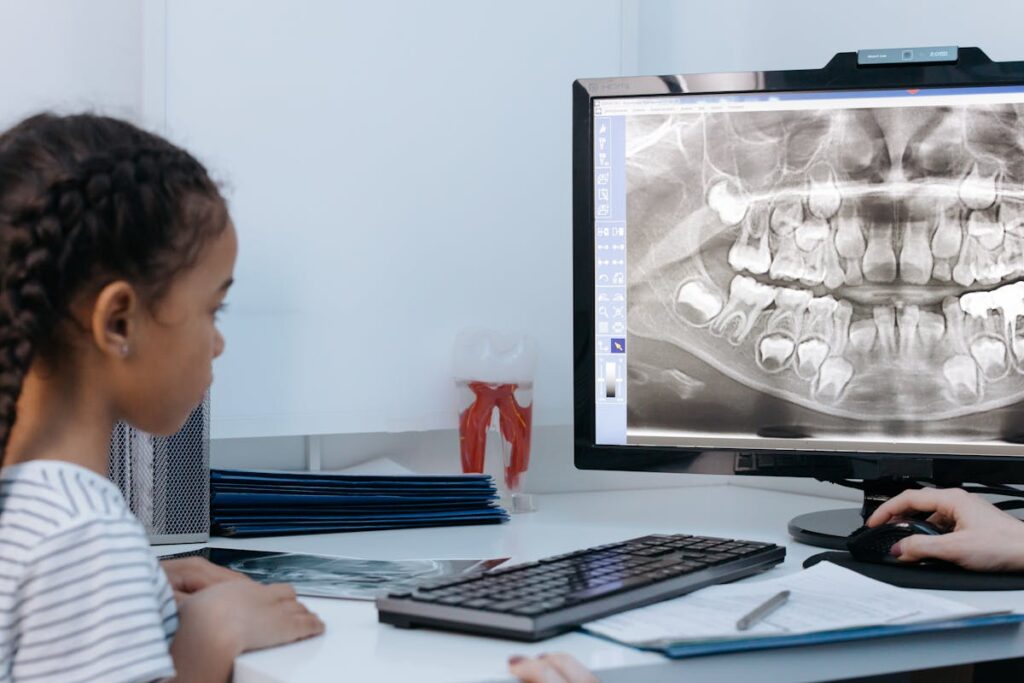
Digital radiography has revolutionized caries detection through enhanced contrast resolution and sophisticated image processing algorithms. Studies demonstrate that digital sensors identify incipient enamel lesions with 15-20% greater accuracy than conventional film. The technology’s ability to detect demineralization before clinical manifestation presents unprecedented opportunities for preventive intervention. However, the relationship between detection sensitivity and false-positive rates raises critical questions about diagnostic thresholds and treatment protocols that practitioners must carefully consider.
How Digital X-Ray Technology Works in Dentistry
When electromagnetic radiation passes through oral structures, digital sensors capture varying levels of X-ray absorption to create detailed diagnostic images. Modern image sensor technology employs either charge-coupled devices (CCD) or complementary metal-oxide semiconductors (CMOS) to convert X-ray photons into electrical signals. These sensors demonstrate superior sensitivity compared to traditional film, requiring 50-80% less radiation exposure.
X-ray beam collimation restricts radiation to specific areas, minimizing patient exposure while maximizing diagnostic accuracy. The collimator’s rectangular aperture focuses radiation precisely on the sensor area, eliminating unnecessary scatter radiation. Digital processing algorithms enhance contrast resolution, enabling detection of demineralization patterns indicating incipient caries development. The technology produces immediate images with 16-bit grayscale depth, providing 65,536 shades of gray versus film’s 256 shades, facilitating identification of subtle density changes characteristic of early-stage cavities.
Types of Cavities Only Visible Through Digital Imaging
Several categories of dental caries remain undetectable through visual examination alone, requiring digital radiographic imaging for accurate diagnosis. Interproximal lesions develop between adjacent teeth where direct visualization proves impossible without separation. These cavities frequently progress unnoticed until significant demineralization occurs, compromising tooth structure integrity.
Microcavities represent incipient enamel breakdown measuring less than 0.5 millimeters, existing below clinical detection thresholds. Digital sensors capture these minute density changes through enhanced contrast resolution, enabling intervention before irreversible damage develops. Occlusal fissure caries beneath intact enamel surfaces similarly evade traditional examination methods.
Recurrent decay beneath existing restorations poses diagnostic challenges without radiographic assessment. Digital imaging penetrates restoration materials, revealing secondary caries formation at margin interfaces. Early identification prevents extensive tooth destruction, reducing invasive treatment requirements and preserving maximum viable tooth structure for long-term oral health maintenance.
Comparing Digital vs. Traditional Film X-Rays for Cavity Detection
Digital radiography demonstrates superior diagnostic capabilities compared to traditional film-based systems through enhanced image resolution that enables detection of incipient carious lesions as small as 0.5mm in depth. Studies indicate digital sensors reduce radiation exposure by 50-80% while achieving sensitivity rates of 96% for proximal surface cavities versus 89% with conventional film. The immediate image acquisition and manipulation features of digital systems allow practitioners to adjust contrast and brightness parameters, revealing early demineralization patterns that often remain obscured on static film radiographs.
Image Quality Differences
Although traditional film radiography served dental diagnostics for decades, digital radiographic systems demonstrate superior contrast resolution that enhances the detection of incipient carious lesions. Digital sensors capture 256 grayscale levels compared to film’s 16-25 levels, providing enhanced differentiation between enamel, dentin, and demineralized tissue structures. This expanded dynamic range enables practitioners to identify subtle density changes indicative of early-stage caries development.
Resolution enhancement algorithms in digital systems further improve diagnostic accuracy through edge sharpening and noise reduction capabilities. Studies indicate digital radiography detects proximal surface caries with 19% greater sensitivity than conventional film. The immediate image clarity allows real-time adjustments of brightness and contrast without retaking exposures, reducing patient radiation dose while optimizing visualization of suspicious areas. These technological advantages support earlier intervention strategies, potentially preventing cavity progression.
Radiation Exposure Levels
While maintaining diagnostic efficacy remains paramount in dental radiography, digital imaging systems reduce patient radiation exposure by 50-80% compared to traditional D-speed film and 20-50% compared to E-speed film. This substantial decrease in radiation dosage levels stems from enhanced sensor sensitivity, requiring shorter exposure times. Digital sensors capture images using 0.005-0.012 seconds of exposure versus 0.10-0.32 seconds for conventional film.
Modern radiation safety protocols emphasize the ALARA principle (As Low As Reasonably Achievable), which digital technology inherently supports. Practitioners can further minimize exposure through collimation, proper angulation, and rectangular positioning devices. The cumulative effect proves significant for patients requiring frequent radiographic monitoring, particularly pediatric populations and individuals with aggressive caries patterns. Digital systems also eliminate retakes from processing errors, preventing unnecessary additional exposures while maintaining diagnostic accuracy for early lesion identification.
Detection Accuracy Rates
When examining diagnostic performance metrics between imaging modalities, detection accuracy rates reveal comparable sensitivity and specificity values for digital radiography and conventional film in identifying occlusal and proximal carious lesions. Studies demonstrate digital systems achieve 85-90% sensitivity for interproximal cavities, matching traditional film performance. Digital radiography’s detection consistency surpasses film through standardized exposure parameters and elimination of processing variables. Advanced algorithms integrated into modern digital systems enhance contrast resolution and edge detection, particularly beneficial for identifying incipient demineralization. Meta-analyses indicate no statistically significant difference in overall diagnostic accuracy between modalities for cavitated lesions. However, digital imaging demonstrates superior performance in detecting early enamel changes through post-processing capabilities. These technological advantages support earlier intervention strategies, aligning with contemporary preventive dentistry protocols focusing on remineralization rather than restoration.
The Science Behind Reduced Radiation Exposure
Digital radiography systems achieve radiation dose reduction through the replacement of traditional film with electronic sensors that demonstrate substantially higher quantum detection efficiency. These sensors require approximately 50-80% less radiation exposure compared to conventional film-based systems while maintaining diagnostic image quality. The phosphor plates and solid-state detectors convert X-ray photons into digital signals more efficiently, capturing more information per unit of radiation.
Advanced imaging technologies incorporate automatic exposure control mechanisms that optimize radiation dosage reduction based on patient anatomy and diagnostic requirements. The direct digital capture eliminates retakes caused by processing errors, further minimizing cumulative exposure. Studies demonstrate that digital systems deliver effective doses ranging from 0.005 to 0.01 millisieverts per intraoral radiograph, markedly below traditional methods. This technological advancement enables practitioners to implement preventive screening protocols with minimal radiation risk to patients.
Reading and Interpreting Digital X-Ray Images
Digital radiographic interpretation requires systematic evaluation of gray scale values, where enamel appears as the most radiopaque structure and dentin exhibits intermediate density relative to surrounding tissues. Early carious lesions manifest as subtle radiolucent areas within the enamel layer, typically presenting at interproximal contact points or along the dentinoenamel junction before clinical symptoms develop. Comparative analysis between intact tooth structure and demineralized regions enables practitioners to quantify mineral loss percentages and implement targeted remineralization protocols before cavitation occurs.
Understanding Gray Scale Values
How do dental professionals distinguish between healthy tooth structure and early decay on digital radiographs? Digital imaging systems utilize a grayscale value range from 0 (black) to 255 (white), representing varying tissue densities. Enamel appears brightest with values typically exceeding 200, while dentin displays intermediate values between 150-180. Early carious lesions manifest as subtle grayscale variations, often showing 10-15% reduction from surrounding healthy tissue.
Accurate grayscale value interpretation requires systematic evaluation of pixel intensity patterns. Demineralized areas exhibit lower grayscale values due to decreased mineral content, appearing darker than adjacent sound enamel. Digital enhancement tools enable practitioners to adjust contrast and brightness, improving visualization of density changes as minimal as 5%. This quantitative analysis surpasses traditional film radiography, facilitating detection of incipient lesions before clinical manifestation becomes apparent.
Identifying Cavity Indicators
When examining digital radiographs for carious lesions, dental professionals systematically evaluate specific anatomical regions where decay commonly initiates. Interproximal surfaces appear as radiolucent areas beneath intact enamel surfaces, indicating demineralization progression. Occlusal caries manifest as triangular-shaped radiolucencies extending from the dentinoenamel junction toward the pulp chamber.
Clinicians assess plaque patterns through radiographic calculus deposits, correlating these findings with cavity development risk. Areas exhibiting persistent bacterial accumulation demonstrate increased radiolucency over sequential imaging periods. Enamel deficiencies present as irregular surface contours or decreased radiodensity, signaling compromised structural integrity susceptible to carious attack.
Digital enhancement tools facilitate detection of incipient lesions measuring 0.5mm or smaller. Density measurements ranging between 40-60 grayscale units typically indicate early demineralization requiring preventive intervention. Evidence demonstrates digital radiography identifies 20% more initial carious lesions than conventional film-based methods.
Comparing Healthy Vs Damaged
The radiographic appearance of sound tooth structure exhibits uniform radiodensity throughout enamel and dentin layers, with distinct anatomical boundaries clearly delineated between tissues. Healthy tooth enamel condition presents as a consistent bright white band surrounding the crown, demonstrating ideal mineralization density. The dentin appears slightly less radiopaque, creating clear contrast differentiation.
Conversely, compromised areas display altered radiographic characteristics indicative of pathological changes. Identifying tooth demineralization requires recognizing subtle radiolucent zones within enamel, appearing as darkened regions disrupting normal radiodensity patterns. Initial carious lesions manifest as triangular-shaped radiolucencies at interproximal contacts, with the base oriented toward the dentinoenamel junction. Advanced lesions demonstrate progressive radiolucency extending through enamel into dentin, exhibiting irregular borders and decreased tissue density. These comparative assessments enable practitioners to differentiate between physiological variations and pathological processes requiring intervention.
When Dentists Recommend Digital X-Rays for Cavity Screening
Although routine dental examinations typically include visual and tactile assessments, dental professionals incorporate digital radiographic imaging at specific intervals based on individual patient risk factors and clinical guidelines. The American Dental Association’s dental routine recommendations specify bitewing radiographs every 12-36 months for adults with low caries risk, while high-risk patients require 6-12 month intervals.
Practitioners consider multiple determinants when prescribing radiographic screening: previous caries history, xerostomia presence, dietary habits, fluoride exposure, and restorative complexity. Interproximal surfaces, particularly posterior contacts, necessitate radiographic evaluation since clinical examination detects only 30% of proximal lesions.
Patient communication needs include explaining radiation exposure minimization through digital sensors, which reduce dosage by 80% compared to conventional films. Clinicians must articulate how early radiographic detection prevents extensive intervention, preserving tooth structure and reducing treatment costs.
Cost-Benefit Analysis of Early Detection Through Digital Imaging
Multiple economic analyses demonstrate that digital radiographic cavity detection yields substantial long-term savings despite initial equipment investments ranging from $5,000-$15,000 per operatory. Studies indicate cost effective screening reduces treatment expenses by 40-60% through early intervention, preventing progression from simple restorations to complex endodontic procedures. Digital imaging enables preventive maintenance protocols that identify incipient lesions requiring minimal intervention, typically costing $150-$300 versus $800-$2,500 for advanced decay treatment.
Insurance claim data reveals patients receiving biannual digital radiographs experience 73% fewer emergency dental visits. The technology’s superior diagnostic accuracy minimizes unnecessary exploratory procedures, reducing false-positive treatments by approximately 30%. Return on investment typically occurs within 18-24 months, with practices reporting increased case acceptance rates when patients visualize pathology on high-resolution monitors. Digital archiving eliminates film processing costs while facilitating longitudinal comparison studies essential for monitoring demineralization patterns.
Limitations and Considerations of Digital X-Ray Technology
While digital radiography substantially enhances diagnostic capabilities, inherent technological constraints limit detection sensitivity for incipient interproximal caries measuring less than 0.5mm in depth. Non-cavitated lesions confined to enamel remain challenging to differentiate from developmental variations or artifacts. Occlusal caries detection accuracy decreases dramatically when demineralization occurs beneath intact enamel surfaces.
Data storage limitations necessitate compression algorithms that potentially compromise image quality, particularly affecting subtle density changes indicative of early pathology. Healthcare facilities must allocate considerable server capacity for DICOM file archiving and implement robust backup protocols. Equipment maintenance requirements include regular calibration of sensors, software updates, and quality assurance testing to prevent diagnostic errors. Sensor degradation occurs progressively, requiring replacement every 5-7 years depending on usage volume. These technological considerations directly impact long-term operational costs and diagnostic reliability in preventive dental practices.
Frequently Asked Questions
How Often Should I Get Digital X-Rays for Cavity Detection?
The recommended frequency for digital radiographic examinations varies between six to twenty-four months, determined by individual caries risk assessment. Modern digital imaging drastically reduces radiation exposure levels while maintaining diagnostic efficacy for preventive cavity detection protocols.
Can Pregnant Women Safely Undergo Digital X-Rays for Cavity Screening?
Pregnant patients should postpone routine dental radiography unless emergencies arise. Modern digital systems minimize fetal radiation exposure through lead aprons and thyroid collars. Evidence-based protocols recommend deferring elective screening until postpartum, prioritizing preventive non-radiographic assessments.
Will My Dental Insurance Cover Digital X-Rays for Preventive Care?
Most dental insurance plans include digital radiographic examinations under preventive care benefits, though coverage limits vary annually. Patients should verify pre-approval requirements, as insurers typically cover bitewing x-rays once yearly for caries detection protocols.
Do Digital X-Rays Hurt or Cause Any Discomfort During the Procedure?
Digital radiographic procedures cause no physical discomfort. Patients experience comfortable chair positioning while sensors capture images. The process involves minimal radiation exposure, lasting seconds per image. No pain occurs as X-rays are non-invasive electromagnetic waves penetrating tissue.
Can Children Have Digital X-Rays Taken for Cavity Detection?
Yes, pediatric dental x-ray procedures are routinely performed using child-friendly x-ray techniques with age-appropriate radiation protocols. Digital radiography offers reduced exposure times and enhanced diagnostic capabilities for detecting interproximal caries in primary and permanent dentitions.